Infertility Signs in Women: What Your Body May Be Trying To Show You
Infertility Signs in Women: What Your Body May Be Trying To Show You
Infertility signs in women are not always obvious.
Sometimes there is no dramatic symptom.
No big diagnosis.
No flashing warning light.
No doctor saying, “This is definitely the reason.”
Sometimes it is quieter than that.
Short cycles. Spotting before your period. Heavy bleeding. Painful periods. Gut issues. Low energy. Inflammation. Recurrent miscarriage. Or month after month of trying when everything looks “normal” on paper.
That is the part many women find so maddening.
Because you can feel something is not adding up, but every isolated test seems to say there is nothing obvious to see.
But fertility does not work in isolated parts.
Your body is not a collection of separate departments. Your cycle, digestion, inflammation, nervous system, hormones, uterine environment, blood sugar, thyroid function, immune signalling and energy levels are all part of the same living system.
So the real question is not only:
“What symptoms do I have?”
The better question is:
“What pattern is my body trying to show me?”
That is where fertility starts making more sense.
Female infertility can involve ovulation disorders, fallopian tube problems, endometriosis, uterine conditions and other factors. Mayo Clinic also notes that cycles that are very long, very short, irregular or absent may suggest ovulation is not happening regularly.
But many women are not short of information.
They are short of interpretation.
The Most Common Infertility Signs Women Search For
Watch my YouTube Video on this topic.
If several of these feel familiar, the point is not to panic. The point is to stop treating them like random separate symptoms.
Infertility Signs in Women: The Pattern Behind the Symptoms
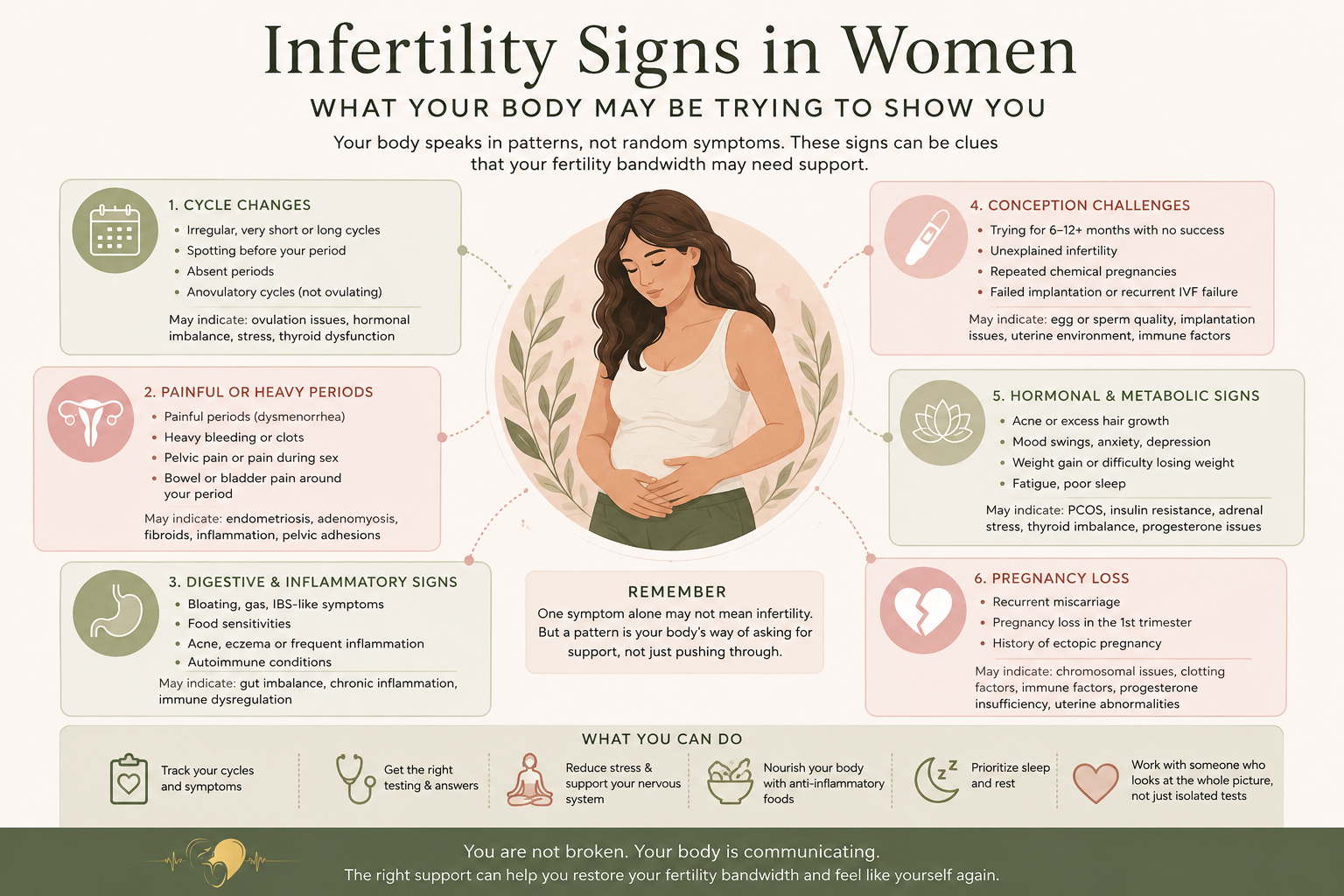
The symptom list is only the doorway. The real value is understanding what pattern those symptoms belong to, because fertility rarely comes down to one isolated body part working or failing on its own.
When women search infertility signs in women or signs of infertility in woman, they are often looking for a list.
So let’s start there.
Possible signs that your fertility may need closer attention can include:
irregular cycles
absent periods
very short cycles
very long cycles
spotting before your period
painful periods
heavy bleeding
clots
pelvic pain
pain during sex
bloating or gut symptoms
acne or excess facial hair
unexplained weight changes
recurrent miscarriage
repeated chemical pregnancies
struggling to conceive after months of trying
failed IVF or failed implantation
being told tests are normal but pregnancy still is not happening
But a list is only useful up to a point.
Because the symptom itself is not always the answer.
It is the clue.
Irregular or absent periods can raise questions around ovulation. Painful periods, pelvic pain or pain during sex can raise questions around endometriosis, adenomyosis, pelvic inflammation or adhesions. Heavy bleeding and clots can raise questions around the uterine environment, fibroids, adenomyosis or hormone signalling.
The NHS lists ovulation problems, blocked or damaged fallopian tubes, endometriosis, fibroids and PCOS among possible causes of infertility.
But the pattern matters more than the label.
That is the part women often miss, because they have been trained to look for one broken thing.
The body is usually showing a story.
Why “Normal Fertility Tests” Do Not Always Mean Everything Is Fine
This is where a lot of women get stuck.
They have blood tests.
A scan.
Maybe an AMH result.
Maybe a semen analysis.
Maybe an HSG.
Maybe thyroid gets checked once.
And then they are told:
“Everything looks normal.”
But normal does not always mean optimal.
And it definitely does not always mean the full pattern has been interpreted.
A basic test can tell you whether one marker falls inside a reference range. It cannot always tell you how your whole body is functioning under load.
That distinction matters.
Because a woman can have “normal” results while still having:
poor cycle quality
inflammatory symptoms
unstable blood sugar
low progesterone signs
thyroid patterns that are not being read deeply
gut issues affecting nutrient absorption
chronic stress physiology
pain patterns being normalised
endometriosis symptoms being missed
immune or clotting questions not yet explored
a uterine environment that is not being properly assessed
This is why unexplained infertility can feel so cruel.
It sounds like an answer.
But often it just means the usual checks have not found the reason yet.
Not that there is no reason.
That is a very different thing.
Short Cycles, Spotting and Irregular Periods
Your cycle is one of the clearest windows into your fertility bandwidth.
Not because every cycle change means something terrible.
But because your cycle gives information.
A shorter cycle may suggest the body is moving quickly through the reproductive rhythm. Spotting before a period can raise questions around progesterone support, lining stability, inflammation, thyroid function, stress load or uterine irritation.
Irregular or absent periods can suggest ovulation may not be happening consistently.
And if ovulation is inconsistent, pregnancy becomes harder because timing, hormone signalling and luteal phase support may all be affected.
This is why I do not love the phrase “just a period problem.”
Your period is not separate from fertility.
It is the monthly report card of the system that is also responsible for ovulation, implantation and early pregnancy support.
So if your cycle is constantly whispering that something is off, it deserves to be listened to.
Not panicked over.
Interpreted.
Painful Periods, Heavy Bleeding and Pelvic Pain
Painful periods are one of the biggest areas where women get dismissed.
Many women are told:
“Some pain is normal.”
And yes, mild discomfort can be normal.
But pain that makes you cancel plans, rely on painkillers, dread your period, feel nauseous, struggle to work, or feel like your pelvis is being wrung out is not something to simply push through.
Especially if you are trying to conceive.
Pain can be information.
Heavy bleeding can be information.
Clots can be information.
Pelvic pain can point towards endometriosis, adenomyosis, fibroids, adhesions, infection history or other pelvic factors. Mayo Clinic describes endometriosis as tissue similar to the uterine lining growing outside the uterus, and notes it can cause pelvic pain and fertility problems.
That is why pain should not be filed away as “just bad periods.”
The body is not being dramatic.
It is communicating.
And when fertility is not happening, those pain patterns become even more important because they may be telling us something about the environment an egg, sperm, embryo or pregnancy is trying to survive in.
Recurrent Miscarriage Is Also Part Of The Fertility Picture
A woman can get pregnant and still be experiencing fertility dysfunction.
This is one of the most painful misunderstandings.
People often say:
“Well, at least you can get pregnant.”
But that can feel like a knife when pregnancy keeps ending.
Getting pregnant and sustaining pregnancy are not the same biological job.
Conception asks one question.
Pregnancy maintenance asks another.
Can the body keep the environment stable enough for this pregnancy to continue?
That brings in the uterine environment, progesterone response, immune signalling, inflammation, blood flow, clotting tendency, thyroid function, nutrient status, sperm quality, stress physiology and overall capacity.
This is why recurrent miscarriage should not be brushed off as “just bad luck” without proper assessment.
Sometimes loss is chromosomal.
Sometimes it is random.
But when there is a repeating pattern, the question changes.
Not:
“Why did this happen once?”
But:
“What is the body struggling to sustain?”
That is where the deeper work begins.
What Causes Infertility In Women?
This is one of the most searched questions because women are often trying to find one clean answer.
But what causes infertility in women is rarely one simple thing.
Sometimes there is an obvious factor, such as irregular ovulation, blocked tubes, endometriosis, PCOS, fibroids, adenomyosis, low ovarian reserve, thyroid issues or male factor fertility.
Sometimes the picture is more layered.
A woman may ovulate, but her luteal phase may be weak.
Her tubes may be open, but pelvic inflammation may still be affecting function.
Her embryos may look good, but the uterine environment may not be receptive enough.
Her AMH may be low, but egg quality, inflammation, mitochondrial energy and overall body capacity still matter.
Her tests may look normal, but the pattern may still be screaming that the body is under too much load.
That is why the better question is not always:
“What causes infertility?”
Sometimes it is:
“What is stopping this body from allocating enough resources to reproduction?”
That question changes everything.
Because the answer may not be one supplement, one hormone, one test or one protocol.
It may be the order in which the body needs support.
Fertility Is Not Just About Ovulation
A lot of fertility advice focuses on ovulation.
Track ovulation.
Confirm ovulation.
Time intercourse.
Use LH strips.
And yes, ovulation matters.
But ovulation is not the whole fertility system.
You also need:
decent egg quality
sperm quality
open and functioning tubes
healthy cervical mucus
stable hormone signalling
a receptive lining
good blood flow
calm enough immune signalling
enough nutrients
enough energy availability
a body that does not feel like it is constantly in survival mode
This is why I talk about fertility bandwidth.
Because reproduction is expensive for the body.
Pregnancy asks for energy, nutrients, immune tolerance, repair, growth, hormone communication and stability.
If the body is already using too much of its capacity dealing with inflammation, stress, poor sleep, gut disruption, pain, blood sugar swings or immune activation, fertility may be deprioritised.
Not because your body is broken.
Because your body is constantly making decisions about what is safest to support.
That is not something to panic about.
It is something to understand.
Infertility Signs Are Often Patterns, Not Isolated Symptoms
This is the part I want more women to understand.
One symptom alone may not tell us much.
But the pattern can tell us a lot.
For example:
Painful periods plus bloating plus pain during sex may point us towards pelvic inflammation or endometriosis-type patterns.
Short cycles plus spotting plus anxiety plus poor sleep may make me think about progesterone support, stress load, thyroid or nervous system strain.
Heavy bleeding plus clots plus pressure may make me think about the uterine environment, fibroids, adenomyosis or inflammation.
Recurrent miscarriage plus “normal tests” may raise questions about immune signalling, clotting, thyroid, progesterone response, uterine environment, sperm DNA quality or inflammatory load.
The point is not to self-diagnose.
The point is to stop treating every symptom as if it belongs in a separate box.
The body does not work like that.
It works like a house.
If the lights are flickering, the heating is unstable, the plumbing is slow and the alarm keeps going off, you would not replace one lightbulb and call the house fixed.
You would ask what is affecting the whole system.
Fertility works the same way.
Why Random Fertility Advice Can Make You More Confused
When women search for fertility help, they usually find more things to do.
Eat this.
Avoid that.
Take this supplement.
Track this hormone.
Try this protocol.
Change this routine.
Some of those things may be useful in the right context.
But more action is not always more clarity.
If you do not know what pattern your body is showing, you can end up adding more pressure to a system that is already overloaded.
That is why the goal is not to do everything.
The goal is to understand what matters most for your body, right now.
A woman with irregular ovulation needs a different sequence from a woman with heavy painful periods.
A woman with recurrent miscarriage needs a different conversation from a woman who has never conceived.
A woman with endometriosis symptoms needs a different map from a woman with PCOS patterns.
A woman who is exhausted, inflamed and running on stress chemistry does not need another random list.
She needs someone to help her interpret what her body is already showing.
That is the difference between collecting information and creating a plan.
What To Ask Before You Panic
If you are worried about infertility signs, start with better questions.
Not frantic ones.
Better ones.
Ask:
Are my cycles regular and ovulatory?
Is there spotting before my period?
Are my periods painful, heavy or clotty?
Do I have pelvic pain, bowel symptoms or pain during sex?
Have I had scans, hormone tests and thyroid markers checked properly?
Has sperm quality been assessed beyond the basics if needed?
Could endometriosis, adenomyosis, fibroids or tubal issues be part of the picture?
Am I dealing with inflammation, stress, gut issues, poor sleep or low energy?
Have I had recurrent miscarriage or chemical pregnancies?
Does my body feel resourced enough to sustain pregnancy?
These questions create a map.
And a map is very different from panic.
Because panic says:
“What is wrong with me?”
Interpretation asks:
“What is my body showing me, and what order does it need support in?”
That is the conversation most women are missing.
When To Get Medical Support
If you are trying to conceive and you are worried, speak with your GP, gynaecologist or fertility specialist.
ASRM states that fertility evaluation is usually appropriate after 12 months of trying for women under 35, after 6 months for women aged 35 or older, and more immediately for women over 40 or where there is a known condition associated with infertility.
You should also seek medical advice sooner if you have:
very heavy bleeding
severe pelvic pain
absent periods
known endometriosis, PCOS, adenomyosis or fibroids
previous ectopic pregnancy
recurrent miscarriage
repeated failed IVF transfers
symptoms that are worsening
pain that interferes with normal life
Medical assessment matters.
But so does interpretation.
Because even when testing is useful, women are often left with pieces of information but no clear understanding of how those pieces fit together.
That is where Fertility Bandwidth is different.
The work is not about collecting more random tips.
It is about understanding the pattern clearly enough that your next step becomes calmer, more strategic and less exhausting.
The Real Meaning Of Infertility Signs In Women
Infertility signs in women are not always loud.
Sometimes they show up as cycle changes.
Sometimes as pain.
Sometimes as inflammation.
Sometimes as recurrent loss.
Sometimes as a deep sense that something is being missed, even when everyone keeps saying things are fine.
And sometimes the sign is simply this:
You are doing the right things, but your body is not responding the way it should.
That deserves more than another list.
It deserves interpretation.
Because fertility is not just about whether you ovulate.
It is about whether your body has the bandwidth to grow, receive and sustain pregnancy.
So if you are searching for infertility signs in women, do not stop at the symptom list.
Ask what the symptoms are connected to.
Ask what pattern they belong to.
Ask what your body has been trying to show you all along.
Next Step: Start With The Free Fertility Analysis
If your symptoms feel like separate problems but your body feels like one connected pattern, start here:
Free Fertility Analysis
https://fertilitybandwidth.com/amnotgettingpregnantwhy
It is designed to help you begin seeing where your fertility may most need support right now, so you are not trying to solve everything at once or guessing from isolated symptoms.
Because clarity changes the next step.
And fertility starts making more sense when the pattern is interpreted properly.
FAQ: Infertility Signs In Women
What are the first signs of infertility in women?
The first signs can include irregular periods, absent periods, very short or long cycles, spotting before a period, painful periods, heavy bleeding, pelvic pain, recurrent miscarriage or struggling to conceive after months of trying. Some women have no obvious symptoms beyond not getting pregnant.
Can you have infertility with normal periods?
Yes. Regular periods can suggest ovulation may be happening, but they do not rule out every fertility factor. Tubal issues, endometriosis, uterine environment, sperm quality, inflammation, thyroid function, immune signalling or implantation problems may still be relevant.
Does unexplained infertility mean nothing is wrong?
No. Unexplained infertility usually means standard testing has not found the cause. It does not always mean there is no reason. Sometimes the issue is the pattern between different systems, not one obvious abnormal result.
When should I get fertility help?
Many guidelines suggest seeking medical advice after 12 months of trying if you are under 35, or after 6 months if you are 35 or older. Seek help sooner if you have irregular periods, severe pain, known reproductive conditions, previous ectopic pregnancy or recurrent miscarriage.
Are fertility supplements enough to fix infertility?
Fertility supplements may be helpful for some women, but they are not a complete fertility strategy on their own. The bigger question is what your body actually needs, whether it can absorb and use support properly, and what order things need to be addressed in.
Find out what's causing you to be infertile for FREE https://fertilitybandwidth.com/amnotgettingpregnantwhy
