Fertility and Conception After 30
You're in your 30s or early 40s. You've probably built your dream career, you're (finally) in the right place emotionally and financially, and now, now you're ready to have a baby. Suddenly, you’re concerned about your fertility and conception. To make matters worse, someone, somewhere, says the words "your age" in that particular tone of voice, and now you feel like you've missed a train you didn't even know was leaving.
Here's what you need to know first: you haven't missed it. But also, you shouldn’t get fobbed off with vague reassurances. Fertility and conception after 30 is absolutely possible, and it happens every day, but you need to start with clarity, not just “another” information.
Start with our Fertility Reset Programmes.
Fertility and Conception: What the Numbers Say
One thing that will genuinely help you is knowing you're not dealing with impossible odds. Someone close to where you live or someone in your town who had passed through a similar situation now has a child. If you ask around, you will find out.
Many more women have also given birth naturally after 30.
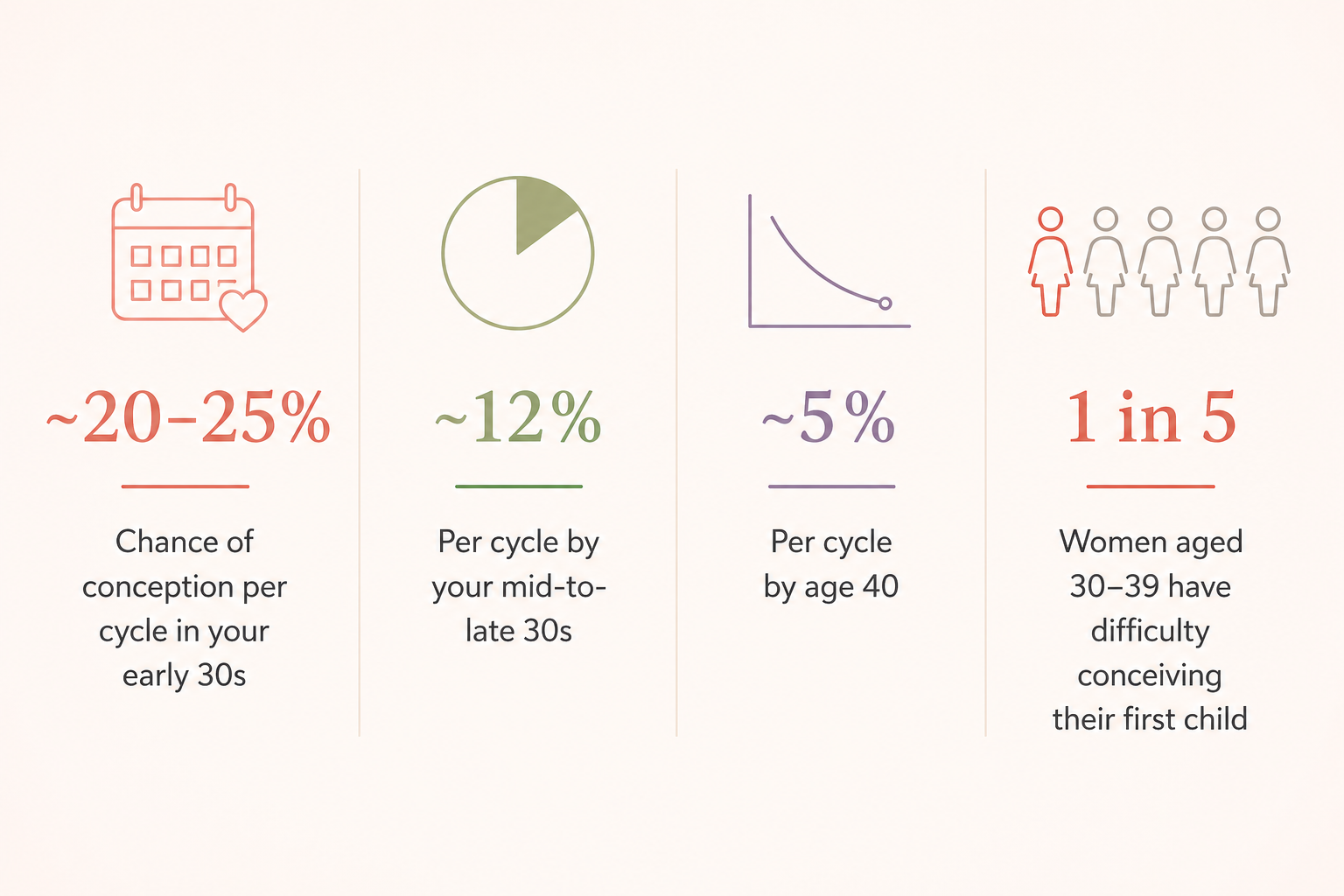
Now, notice something about those numbers. Even at 40, a 5% chance per cycle isn't zero. And over 12 months of trying, those cycles add up. Many, many women conceived pregnancy in their late 30s and early 40s.
What matters most as you age is timing. You must start with clarity and immediately. The more time you waste moving in a maze or just trying random online techniques, the less your chances of getting pregnant naturally, or even having a healthy child.
You can start with our bespoke Fertility Reset Programmes to find out what the regular tests couldn’t pick and what really could be holding you back. Most importantly, get help and get pregnant fast.
It's also worth knowing that according to the British Fertility Society, around 30% of fertility issues are actually on the male side. Another research attributes 50% of infertility to male factors. So, if things aren't happening, it's not automatically about your age or your body. This is a conversation you will need to have with your partner.
Understanding Your Women's Fertility Cycle
If there's one thing that makes the biggest difference to conception fertility, it's this: knowing your cycle. Not just "when your period is due", but actually understanding what your body is doing across those 28 (give or take) days. Because here's the thing that surprises a lot of women: you can only conceive during a window of roughly 6 days per cycle.
The egg is viable for just 12–24 hours after ovulation. Sperm, however, can survive in the reproductive tract for up to 5 days. So your real window is the 5 days before ovulation and the day of ovulation itself. Miss that window, and that month's opportunity is gone, no matter how much sex you're having.
This is especially critical for women in their 30s and 40s, because your fertility cycle may become less predictable as you age. Cycles that were once clockwork might shorten, lengthen, or become irregular, all of which can shift when you're actually ovulating.
The Four Phases of Your Fertility Cycle — and What They Mean for Conception
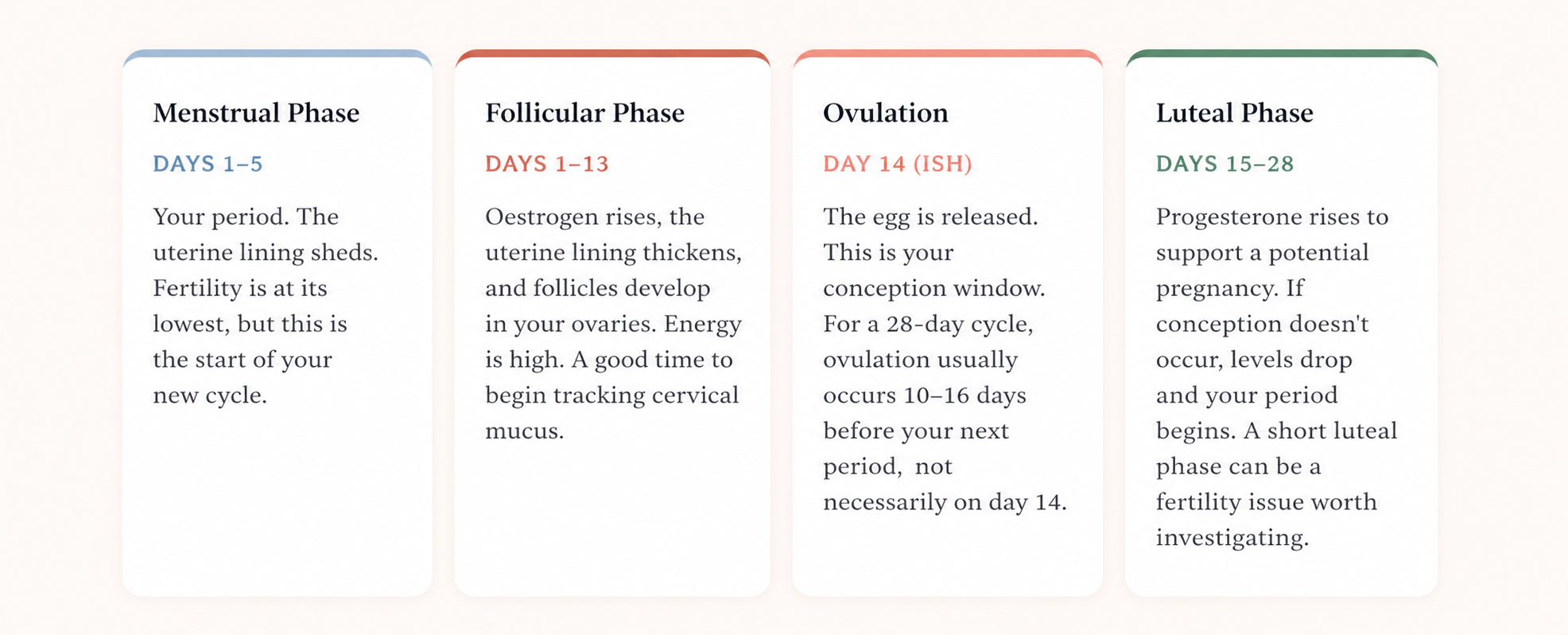
Important note: If you have PCOS, standard OPKs can be misleading because your LH levels may already be slightly increased. In that case, BBT and mucus tracking become even more important.
Fertility After Pregnancy: The Second-Time Struggle
Here's something that most women miss: fertility after pregnancy isn't guaranteed to be easier the second time around. In fact, there's a term to describe the difficulty of getting pregnant after the first pregnancy: it’s called secondary infertility. It affects a surprising number of women, and that many feel completely blindsided by.
Secondary infertility can happen for a number of reasons:
Age, if you had your first pregnancy late or several years have passed since your first pregnancy, your ovarian reserve will have significantly decreased
Changes in your partner's sperm quality since the first pregnancy
New conditions that may have developed, such as endometriosis, fibroids, or thyroid issues
Hormonal shift after pregnancy, particularly if you're still breastfeeding (prolactin suppresses ovulation)
C-section scarring, in some cases, can affect the uterine lining
If you're breastfeeding, your periods and ovulation may not return to normal for several months after you stop.
When to Stop Waiting and Seek Help
One of the most damaging myths in the world of conception fertility is that you should "just keep trying" for as long as possible before seeing a specialist. Time is fertility, and for women over 35, the sooner you get the right answers, the better your options.
Your GP should carry out a proper investigation, including blood tests to check your hormone levels (including AMH, anti-Müllerian hormone, which gives an indication of your ovarian reserve), a semen analysis for your partner, and an ultrasound scan to check your ovaries and uterus.
After getting your diagnosis properly done, the next step is to see a fertility specialist.
If you're over 35, your age makes waiting a genuinely costly decision.
Fertility Myths That Are Frankly Wasting Your Time
You may have gulped a ton of well-meaning hypes and myths about pregnancy and fertility. Let's clear some of it up.
❌ "Legs in the air after sex increases your chances"
There's no scientific evidence for this. Sperm are fast and have a tail to swim to the egg. They don't need a gravity assist. The acrobatics just aren't necessary.
❌ "You can't get pregnant while breastfeeding"
You can. Breastfeeding suppresses ovulation in many women, particularly in the early months, but it's not a reliable contraceptive. Ovulation can return before your period does, meaning you can conceive before you even know your cycle has restarted.
❌ "You can only conceive on day 14"
This is based on the assumption that everyone has a 28-day cycle and ovulates at the midpoint. Many women don't. Ovulation typically occurs 10–16 days before your next period, which in a longer cycle might be day 18 or even later. Tracking your cycle properly is the only way to know when you actually ovulate.
❌ "If you conceived once, you'll conceive easily again"
As we covered in the section on fertility after pregnancy, secondary infertility is real and relatively common. A previous pregnancy doesn't guarantee the next one will happen easily or at all without support.
FAQ
How long does it realistically take to conceive in my 30s?
Most couples trying to conceive pregnancy — even in their 30s — will do so within a year of trying. For women aged 30–35, around 94% will conceive within two years of regular unprotected sex. That figure drops with age, but the majority of women in their late 30s who have no underlying conditions will still conceive naturally within this timeframe. The critical thing is to not wait too long before seeking help if it isn't happening.
Do contraceptive pills affect fertility after stopping?
For most women, fertility returns within 1–3 months of stopping. About 80% of women are able to get pregnant within 12 months, regardless of how long they’ve been using the contraceptives. If your periods don't return to a regular pattern within a year, it's worth seeing your GP.
What does AMH actually tell me about my fertility?
AMH (Anti-Müllerian Hormone) indicates how many eggs you have left. A low AMH means a lower number, which can make natural conception harder and may affect how you respond to fertility treatments. However, AMH isn’t a measure of egg quality, and some women with low AMH do get pregnant naturally.
Can I improve my egg quality?
Some lifestyle factors, particularly a nutrient-rich diet, managing oxidative stress through antioxidants like CoQ10, and avoiding smoking, may support egg quality. Using a CoQ10 supplement has been found to increase egg quality, though not a guarantee.
Is IVF my only option if I'm struggling to conceive?
Not at all. Depending on the cause of your difficulty conceiving, there are a range of options. You can adjust lifestyle, try ovulation induction (using medication to stimulate ovulation) or IUI (intrauterine insemination) before considering IVF. If you want to know the best option for you, talk to Karen Botha, a fertility specialist at Fertility Bandwidth.
How much does fertility decline each year after 35?
Your fertility doesn’t decline all of a sudden. It isn't a cliff edge . It's a gradual slope that steepens in the late 30s. Fertility is at its peak in your twenties and gradually declines until it comes to a halt at menopause.
Your Next Steps
Whether you're just starting to think about pregnancy and conception or actively trying, knowing your fertility bandwidth is your best strategy. In addition, you need to go beyond what’s obvious. Your cycle, your hormones, your fertile window. You need to understand that your body needs to survive first before it can accommodate pregnancy. That’s what our fertility bandwidth model helps you to do.
And if you're struggling, whether it's with natural conception, with fertility after pregnancy, or with the emotional weight of a journey that isn't going the way you hoped, start with our Fertility Reset Programmes.
Karen Botha
Karen Botha is a root cause fertility practitioner who helps couples identify the deeper health pressures that may be affecting conception by combining Western Scientific data with Eastern wisdom.
