
Adenomyosis Symptoms and Fertility
Adenomyosis Symptoms: The List That Matters When You’re Trying To Conceive
Adenomyosis symptoms are often dismissed as “just bad periods.”
Heavy bleeding. Clots. Deep cramping. Bloating. Pelvic pressure. Pain during sex. A uterus that feels swollen, heavy or angry every month.
But if you are trying to conceive, those symptoms deserve more than a shrug.
Because adenomyosis is not just about uncomfortable periods. It can affect the environment inside the uterus — and the uterus is not just where pregnancy happens.
It is the house a pregnancy has to live in.
So if that house is inflamed, irritated, poorly supplied, enlarged, tense or under strain, the question is not only, “Am I ovulating?”
The better question is:
What kind of environment is my body asking a pregnancy to settle into?
That distinction matters.
Adenomyosis happens when tissue similar to the lining of the womb grows into the muscular wall of the uterus. Common symptoms include heavy menstrual bleeding, painful cramps, pelvic pain, painful sex, bloating, an enlarged uterus and, for some women, fertility struggles. Cleveland Clinic lists infertility among possible signs of adenomyosis, and research has linked adenomyosis with poorer IVF outcomes and increased miscarriage risk in some women.
But symptoms are not the whole story.
They are clues.
And when you understand the pattern behind them, fertility starts making much more sense.
The Adenomyosis Symptom List Most Women Search For
If you are searching for an adenomyosis symptom list, you are probably trying to work out whether what you are experiencing is normal.
Or whether something has been missed.
Common adenomyosis symptoms can include:
heavy periods
painful periods
severe cramping
pelvic pain
pain during sex
spotting or abnormal bleeding
blood clots
bloating or abdominal fullness
lower back pain
pressure in the pelvis
a uterus that feels heavy, swollen or tender
fertility struggles
recurrent pregnancy loss in some cases
Some women have very obvious symptoms.
Others have surprisingly few.
If several of these feel familiar, the point is not to panic. The point is to stop treating them like random separate symptoms.
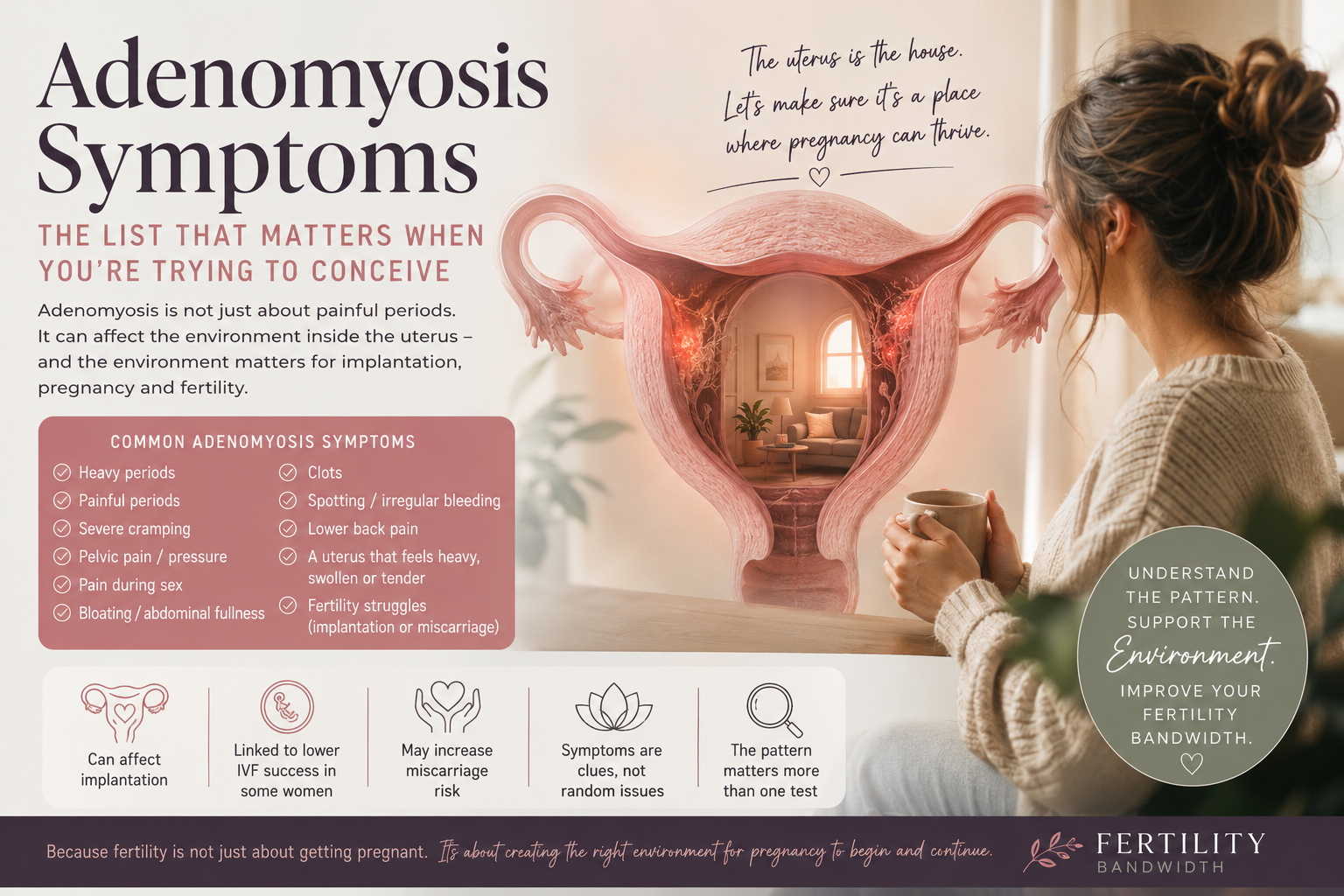
The fertility question is not only whether these symptoms are present. It is what they may be telling us about the condition of the womb itself.
That is one of the reasons adenomyosis can be so confusing. Cleveland Clinic notes that around one in three people with adenomyosis may have no signs or symptoms.
So the point is not to diagnose yourself from a list.
The point is to stop brushing off symptoms that may be telling you something important about the condition of your womb.
Especially if you are TTC, preparing for IVF, struggling with implantation, or dealing with recurrent miscarriage.
Adenomyosis Symptoms Are Not Just Separate Problems
This is where many women get missed.
One doctor looks at the heavy bleeding.
Another looks at the pain.
Someone else looks at the fertility struggles.
Then you are told your hormones are “fine,” your scans are “not too bad,” or you can “just try IVF.”
But the body does not work in separate departments.
Heavy bleeding, pelvic pain, bloating, clots, pressure and fertility struggles may all be different warning lights on the same dashboard.
The question is not:
“What pill gets rid of this symptom?”
The better question is:
“What pattern is creating these symptoms in the first place?”
Adenomyosis can be part of a wider picture involving inflammation, uterine irritation, altered blood flow, immune signalling, hormone sensitivity, pelvic congestion, endometriosis, adhesions, stress load or overall body capacity.
That does not mean adenomyosis is always the only issue.
It means it may be one visible piece of a bigger fertility pattern.
And when you are trying to conceive, that matters.
Read: Getting Pregnant After Miscarriage
Because fertility is not just about releasing an egg.
It is about whether the body has the bandwidth to support the whole process from ovulation to implantation to pregnancy maintenance.
Why Heavy, Painful Periods Matter When TTC
Heavy, painful periods are often normalised.
Women are told:
“That’s just your cycle.”
“Some women bleed heavily.”
“Period pain is common.”
And yes, mild cramping can be normal.
But periods that flood, exhaust you, cause clots, leave you planning your life around bleeding, or make you feel like your uterus is trying to turn itself inside out are not something to simply endure.
Mayo Clinic describes adenomyosis as a condition where tissue in the uterine wall thickens, breaks down and bleeds during the menstrual cycle, which can make the uterus larger and periods painful and heavy.
From a fertility perspective, this matters because the period is not separate from fertility.
Your period is the monthly report card of what has been happening in the womb.
If the bleed is extremely heavy, painful, clotty, prolonged or inflamed-feeling, it may be telling us that the uterine environment has been under strain.
That does not automatically mean you cannot conceive.
But it does mean your symptoms deserve interpretation, not dismissal.
The womb is not just a passive container.
It is active tissue. It responds. It contracts. It communicates. It receives signals. It builds a lining. It sheds. It repairs.
Watch: Adenomyosis Symptoms Are Not Just Bad Periods
So when symptoms are loud every month, I want to know why.
Not because I want you to panic.
Because clear interpretation gives you better next steps.
Adenomyosis and Fertility: What Often Gets Missed
The biggest mistake is thinking fertility is only about whether sperm meets egg.
That is one part.
But it is not the whole story.
Adenomyosis sits in the uterus itself. So when we talk about adenomyosis and fertility, we are not only asking whether conception can happen.
We are asking whether the uterine environment can support implantation and early pregnancy.
That is a very different question.
Research has increasingly associated adenomyosis with fertility and IVF challenges. A 2023 literature review describes adenomyosis as a common gynaecological disorder affecting reproductive-age women and reports negative effects on IVF outcomes. A 2024 meta-analysis found women with adenomyosis had a significantly higher miscarriage rate than women without adenomyosis in the included IVF/ICSI data.
This does not mean adenomyosis makes pregnancy impossible.
It does not mean your body is broken.
It means the womb environment may need to be understood properly.
Because implantation is not just an embryo “sticking.”
It is communication.
The embryo and the womb have to recognise each other. The lining has to be receptive. Blood flow, immune signals, inflammation, hormones and energy availability all have to coordinate.
If the house is constantly inflamed, tense, swollen or under repair, it may be harder for pregnancy to begin or continue smoothly.
That is the part that often gets missed when the conversation becomes only about egg quality, age or embryo grading.
Adenomyosis, IVF and Implantation
A lot of women assume that if they are doing IVF, uterine conditions matter less.
But IVF does not bypass the uterus.
IVF may help create the embryo and get it to the front door.
It does not automatically fix the house it is arriving into.
That is why adenomyosis can still matter during IVF.
If the uterine muscle is enlarged, inflamed, irritated or contracting differently, that may affect receptivity, implantation and pregnancy maintenance.
Several studies and reviews have associated adenomyosis with poorer IVF outcomes, including reduced clinical pregnancy rates, lower live birth rates or increased miscarriage risk, although individual outcomes vary and treatment decisions should always be discussed with a fertility specialist.
This is where women often feel blindsided.
They are told:
“The embryo looked perfect.”
“The transfer went well.”
“Your lining looked okay.”
Then it still does not work.
And the conclusion becomes:
“Maybe it was just bad luck.”
Sometimes it is.
But sometimes the embryo was only one part of the story.
The environment mattered too.
That is why I always want women to look at the whole fertility picture before assuming the next step is simply more medication, more supplements, or another transfer with the same underlying pattern still running.
Read: IVF Preparation
Adenomyosis Symptoms Can Overlap With Endometriosis
Adenomyosis and endometriosis are different conditions, but they can overlap.
Endometriosis involves tissue similar to the uterine lining growing outside the uterus.
Adenomyosis involves tissue growing into the muscular wall of the uterus.
Both can be linked with pain, inflammation, heavy periods, pelvic symptoms and fertility struggles.
And in the real world, symptoms are not always neat.
A woman may have heavy bleeding from adenomyosis, pelvic inflammation from endometriosis, digestive symptoms from inflammatory load, fatigue from chronic pain, and fertility struggles being blamed only on age.
That is why symptom lists are useful, but limited.
They tell us what is happening.
They do not always tell us why.
And they rarely tell us what order to address things in.
That is the missing piece.
Read: Endometriosis: What It Is And Why You Can’t Get Pregnant
Because if the body is already overwhelmed, throwing random fertility supplements, restrictive diets, intense exercise, more testing and more pressure into the system can become another load.
Not because those things are always wrong.
Because sequence matters.
The body responds best when it is supported in the order it can actually use.
When Adenomyosis Symptoms Should Be Checked
If you suspect adenomyosis, it is important to speak with your GP, gynaecologist or fertility specialist.
Especially if you have:
very heavy bleeding
severe period pain
pelvic pain outside your period
pain during sex
bleeding between periods
recurring clots
fertility struggles
failed IVF transfers
a known history of endometriosis
a scan showing an enlarged or abnormal-looking uterus
Adenomyosis can be investigated through clinical history, pelvic examination, ultrasound, MRI and specialist assessment, depending on your situation.
But here is the important part.
Getting a label is not the same as understanding the full pattern.
A diagnosis can explain part of the picture.
But it does not automatically tell you what your body needs next.
That is where interpretation matters.
Because two women can both have adenomyosis and need very different support depending on their inflammation, stress load, blood sugar, gut health, nutrient status, cycle pattern, IVF history, miscarriage history, age, sleep, immune picture and overall capacity.
This is why I do not love isolated advice.
The body is not isolated.
Your fertility plan should not be either.
What This Really Means If You Are Trying To Conceive
If you are searching adenomyosis symptoms because something feels wrong, you are not being dramatic.
Your body may be giving you useful information.
Heavy bleeding, pain, bloating, clots, pelvic pressure and fertility struggles are not random inconveniences to push through.
They may be clues about the condition of the womb.
And the womb matters.
Not just because it holds pregnancy.
Because it communicates with pregnancy.
It receives. It responds. It adapts. It supports. It protects.
So if the house is inflamed, overloaded or under strain, the answer is not simply to shout louder at the body with more interventions.
The answer is to understand the pattern.
What is driving the inflammation?
What is affecting the uterine environment?
What is the body prioritising?
What has been missed because your tests looked “normal enough”?
What would need to change before your body has a better chance of receiving and sustaining pregnancy?
That is the level of clarity most women are missing.
And once you can see the pattern, the next step becomes much less overwhelming.
Next Step: Understand The Pattern Before You Panic
Adenomyosis symptoms can feel frightening when you are trying to conceive.
But panic does not give you power.
Interpretation does.
The goal is not to diagnose yourself from a symptom list or assume the worst because you recognise parts of your experience here.
The goal is to stop treating your symptoms like disconnected problems.
Because your body is always telling a story.
The question is whether someone is reading it properly.
If you have adenomyosis, suspected adenomyosis, heavy painful periods, failed IVF, implantation issues, recurrent miscarriage or “unexplained” fertility struggles, the next step is not more random advice.
It is clarity.
Because fertility is not just about whether you can get an embryo.
It is about whether your body has the bandwidth to create, receive and sustain pregnancy.
And when you understand that, everything starts to make more sense.
FREE FERTILITY ANALYSIS https://fertilitybandwidth.com/fertilityresetprogrammes
FAQ section
FAQ: Adenomyosis Symptoms and Fertility
What are the most common adenomyosis symptoms?
Common adenomyosis symptoms include heavy periods, painful periods, pelvic pain, cramping, bloating, pain during sex, spotting, clots, lower back pain and a heavy or swollen feeling in the uterus. Some women have fertility struggles, while others have very few obvious symptoms.
Can adenomyosis affect fertility?
Adenomyosis may affect fertility in some women because it involves the uterus itself. It may influence the uterine environment, implantation, inflammation, blood flow and pregnancy maintenance. Research has linked adenomyosis with reduced IVF outcomes and increased miscarriage risk in some groups, although individual cases vary.
Can you get pregnant with adenomyosis?
Yes, some women with adenomyosis do get pregnant. Adenomyosis does not automatically mean pregnancy is impossible. But if you are struggling to conceive, experiencing recurrent miscarriage, or having failed IVF transfers, it is worth understanding whether adenomyosis may be part of the wider pattern.
Why normal fertility tests can still miss the pattern - find your pattern
Does adenomyosis cause heavy periods?
Adenomyosis can cause heavy menstrual bleeding and painful periods. This happens because tissue within the uterine wall can thicken, break down and bleed during the menstrual cycle, which may enlarge the uterus and increase pain or bleeding.
Is adenomyosis the same as endometriosis?
No. Adenomyosis and endometriosis are different. Adenomyosis involves endometrial-like tissue growing into the muscular wall of the uterus. Endometriosis involves endometrial-like tissue growing outside the uterus. They can overlap and both may be relevant in fertility struggles.
Should I see a doctor if I think I have adenomyosis?
Yes. If you have very heavy bleeding, severe period pain, pelvic pain, pain during sex, fertility struggles, recurrent miscarriage or failed IVF transfers, speak with your GP, gynaecologist or fertility specialist. This article is educational and should not replace medical assessment.
If your symptoms feel like separate problems but your body feels like one connected pattern, start with the Free Fertility Analysis. It is designed to help you begin seeing what may be affecting your fertility bandwidth, instead of guessing from isolated symptoms.
This article is for educational and informational purposes only and does not replace medical advice, diagnosis or treatment. If you are concerned about adenomyosis symptoms, heavy bleeding, severe pain, fertility struggles or recurrent pregnancy loss, please speak with your GP, gynaecologist or fertility specialist.
